Sphingolipid Signaling and Immunology of Surgical Diseases
- Metabolism and intra- and extracellular action of S1P
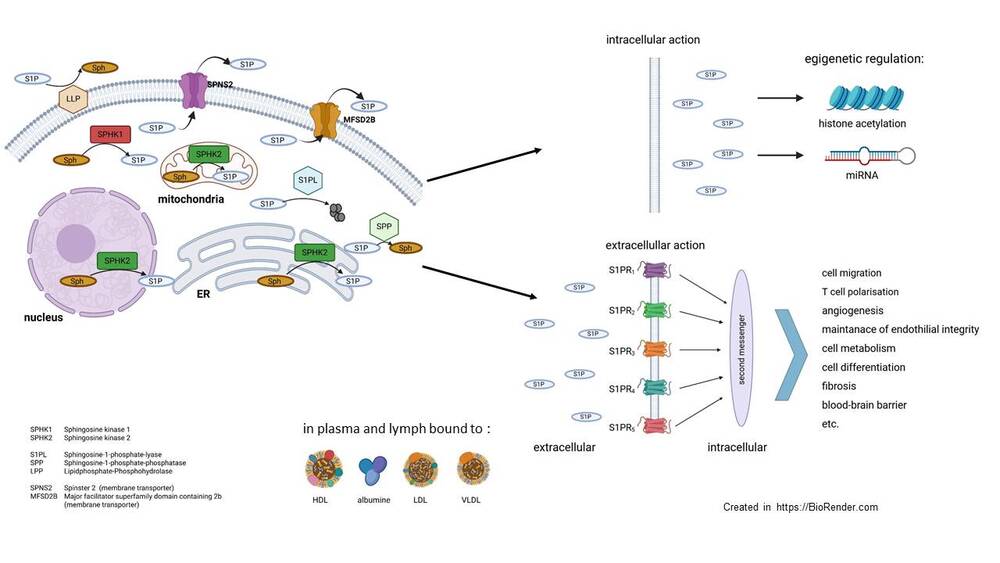
The main research focus of the working group "Sphingolipid Signaling and Immunology of Surgical Diseases" is the investigation of the influence of sphingolipids on the maintenance of the intact immune defense of the peritoneal cavity and in the development of various disease entities that play a relevant role in the clinical spectrum of surgery. At the center of our research is the lysophospholipid sphingosine-1-phosphate (S1P), which can act both as an extracellular and intracellular signaling molecule (Figure T1). Among other things, it is essential in the regulation of numerous biological processes such as the control of hematopoietic cell migration, positioning of immune cells in tissue context and the control of vascular integrity and tumor cell behavior. This central position in important biological processes makes understanding of S1P action in the pathophysiology of various surgical diseases particularly fascinating, on the one hand to be able to take into account changes in S1P signaling induced by surgical interventions, on the other hand to explore S1P as a pharmacologically accessible target to improve the outcome of surgical and multimodal therapy concepts. The synthesis of S1P is highly regulated and organ- and cell-specific, as well as subcellularly compartmentalized. Local S1P levels are the result of the activity of S1P-synthesizing and S1P-degrading enzymes as well as the activity of transport proteins that ensure the export of intracellularly produced S1P into the extracellular space (Figure T1). The level of S1P in the respective compartment determines the S1P gradient, which, among other things, forms the basis for the chemotactic effect of this signalling molecule and thus for the positioning of immune cells within secondary lymphoid organs and other tissue structures. In contrast to the formation of S1P levels in blood and lymph, the mechanisms of regulation of intraperitoneal and intrapleural S1P levels as well as a mapping of local S1P levels within the organ architecture have not yet been established and are therefore a focus of our research group.
Another focus of the working group is investigating the influence of diversion colitis on immune homeostasis. Diversion colitis is a spontaneously developing mucosal inflammation of sections of the colon that are excluded from stool transport as a result of a surgical procedure. The causes that are held responsible for the development of this inflammation range from changes in the microbiome to a lack of important nutrients for the enterocytes that are transported with the chyme and thus provided by the lumen. While the local changes in the intestinal wall have already been well characterized, the influence of the mechanisms that lead to local inflammation or the influence of local inflammation itself on the systemic and, in particular, antitumour immune response has not yet been investigated. The characterization of this change is at the center of this second focus of our research group. For this purpose, we utilize a murine model of diversion colitis, which was established in our laboratory and which accurately represents the pathophysiological mechanisms of the human disease (Figure T2).
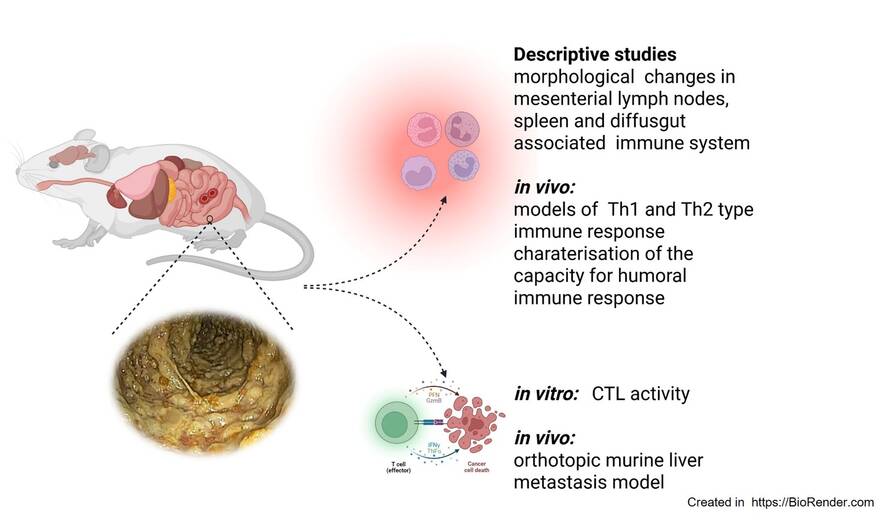
- Figure T2: Impact of diversion colitis on immune homeostasis and immune response